CheqOne updates
برنامج طباعة شيكات للشركات for Better Control
Select a برنامج طباعة شيكات للشركات for accurate printing, bilingual amounts, controlled access, audit trails, and clearer post-dated cheque planning.
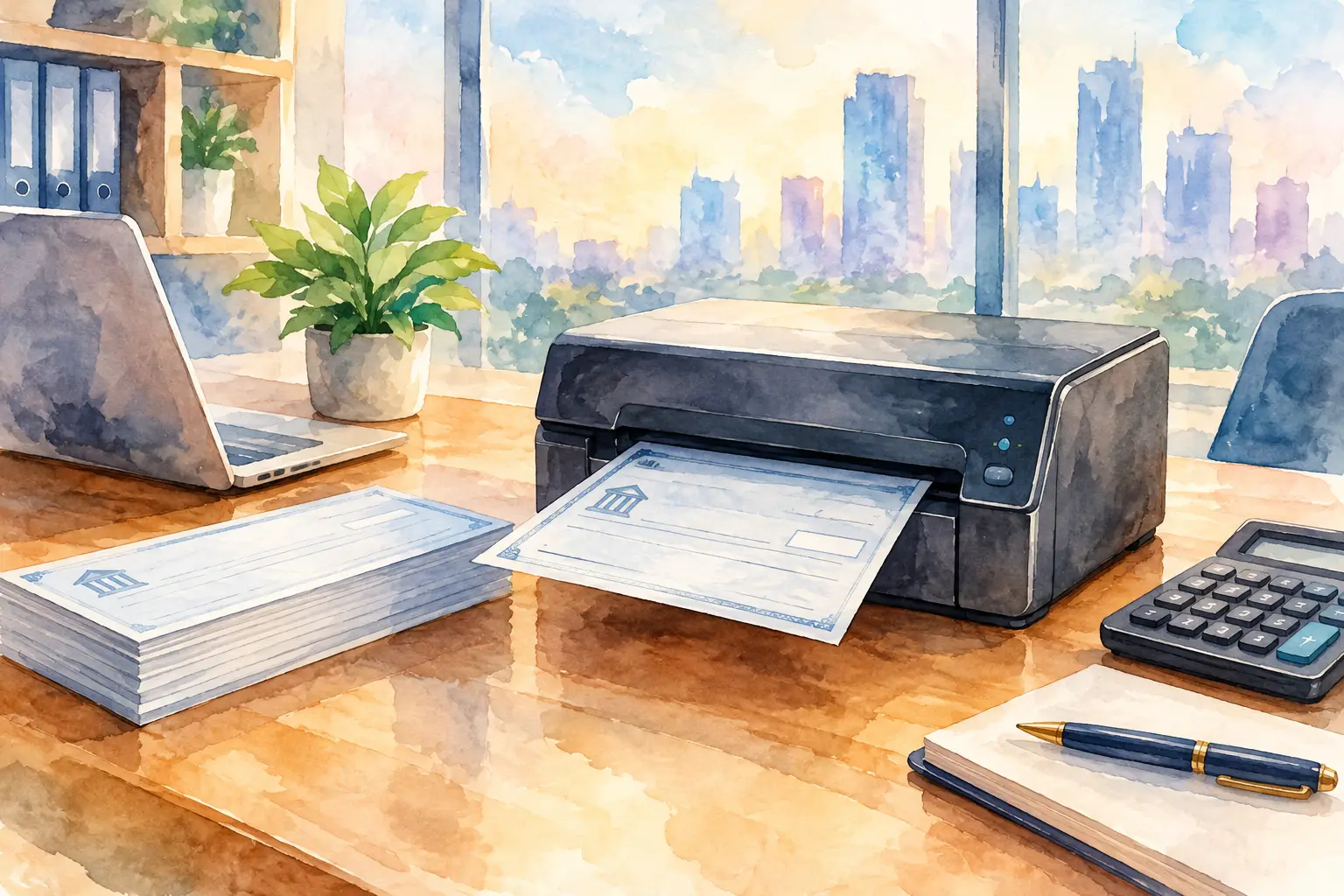
A cheque can be correctly approved, correctly funded, and still become a problem when it is printed on the wrong leaf, misaligned by a few millimeters, or missing from the payment register. That is why a برنامج طباعة شيكات للشركات should be treated as a finance-control system, not merely a faster way to fill out cheque fields.
For businesses that issue supplier payments, rent cheques, installments, or post-dated cheques, the right system brings printing, authorization, cheque-book records, and payment status into one calm place. It reduces avoidable rework while preserving the evidence finance teams need when a payment is questioned weeks or months later.
What a cheque printing program must control
A basic cheque-writing tool can place a payee name and amount on paper. That is useful, but it does not solve the full operational risk. Finance teams also need certainty about which company issued the cheque, which bank account and cheque leaf were used, who prepared it, who printed it, and what happened after delivery.
A capable program should maintain a structured cheque register from the moment a cheque is created. Each record should carry the cheque number, bank account, payee, amount, issue date, due date, and current status. The status matters because an issued cheque is not necessarily cleared. It may be delivered, post-dated, honored, dishonored, canceled, or still awaiting presentation.
This distinction becomes especially valuable when several people handle payments. An accounts payable employee may prepare a batch, an authorized manager may review it, and a different employee may print it from an approved computer. Without a shared record, those handoffs often end in spreadsheets, email threads, and uncertainty over the next available cheque number.
Accurate printing is more than a good-looking cheque
Cheque forms vary by bank, and printer behavior varies by device. A layout that looks correct on screen can place the date, payee, or amount too high or too far left on the actual cheque. Reprinting without a controlled process can create a second risk: the original leaf may appear unused even though it has already been marked or partially printed.
The practical standard is precise field alignment that can be adjusted for the selected cheque format and printer. Finance teams should be able to test alignment on plain paper, make measured corrections, and print only when the output is confirmed. A Windows-based print helper is often useful here because it connects browser-based cheque creation to the printer installed on an approved office PC.
Printer compatibility also deserves attention. A business may use a laser printer in one office, a dot-matrix printer for continuous stationery in another, and a dedicated cheque printer at headquarters. The software should support the equipment already used by the finance team rather than forcing an expensive hardware change.
For UAE and GCC operations, bilingual amount wording is another operational requirement. Amounts should be generated consistently in both English and Arabic, with wording that corresponds to the numeric value. Typing amounts in words manually introduces errors that are hard to spot, particularly in high-value or decimal amounts.
Check the bank layouts before you commit
A ready-made layout for the bank and cheque design in use will shorten deployment. However, ready-made layouts alone are not enough for a group with older cheque stock, special formats, or multiple banks. Look for a layout designer or configuration process that can accommodate additional formats without rebuilding the entire workflow.
The goal is not to make every cheque look identical. The goal is to make each bank format print correctly, consistently, and with an auditable configuration behind it.
Why cheque-book tracking changes the workflow
A cheque book is a controlled financial instrument. Each leaf has a number, belongs to a bank account, and can be voided, used, or remain available. When that information lives in a drawer or a separate spreadsheet, the next cheque number is often determined by assumption rather than a verified record.
A better process registers the cheque book before printing begins. The finance user records the bank account, cheque number range, and current position. When a cheque is issued, the system assigns and tracks the leaf. If a leaf is spoiled during a printer test or canceled after preparation, its status should remain visible rather than disappearing from the sequence.
This protects against duplicate numbers and unexplained gaps. It also makes handovers easier. A finance manager can see which cheque books are active, which ranges are nearly finished, and which leaves need investigation without checking physical files one by one.
The right control level depends on the business. A company issuing a few cheques per month may need simple sequential tracking. A group with several entities, bank accounts, and finance users needs centralized visibility across all of them, with each user limited to the companies and functions relevant to their role.
Choose permissions and audit trails that reflect real responsibilities
Cheque printing should not be an unrestricted shared login activity. Access controls should mirror the payment workflow: some users prepare data, some print, some manage cheque books, and some only review reports. This is not about making the process difficult. It is about ensuring that authority is clear when an exception occurs.
An audit trail should show meaningful events, such as creation, edits, printing, cancellation, status changes, and user activity. If a cheque is reprinted, the record should make that visible. If a payment is marked dishonored, finance should be able to identify when the status changed and who recorded it.
For multi-company businesses, centralized access is particularly helpful. The group administrator can manage users and settings from one workspace while keeping each legal entity, bank account, and cheque register properly separated. That removes the need for isolated desktop files and reduces dependence on one employee's local computer.
Post-dated cheques need planning, not just storage
A post-dated cheque is a future obligation that affects cash planning before it reaches the bank. If upcoming cheques are recorded only after they are printed, management loses a useful view of future payment exposure.
The program should let finance teams create post-dated cheques in batches, assign future dates accurately, and report on what is due by week, month, company, account, or payee. A scheduled rent series and a set of supplier installment cheques should be easy to review alongside one another.
This is where cheque printing software becomes more than a printing utility. It creates a reliable operational picture: what has been issued, what is due next, what has cleared, and what requires follow-up. That clarity supports treasury planning without asking the team to rebuild the same information in another spreadsheet.
How to assess a برنامج طباعة شيكات للشركات
Start with your actual cheque workflow rather than a generic feature list. Identify how many companies, bank accounts, cheque books, users, and printer types are involved. Then confirm how the system handles your bank layouts, Arabic and English amount wording, post-dated batches, cancellations, reprints, and historical records.
Ask to see the setup path from start to finish. A practical system should allow the team to configure a company, add bank accounts, register cheque books, select a layout, test the printer, and begin issuing cheques without a long implementation project. Import support is also valuable when historical registers need to remain available for reference and reporting.
CheqOne is designed around this workflow, combining browser-based cheque preparation with controlled local printing, bank-format support, cheque-leaf tracking, status management, and role-based access. The value is not simply fewer handwritten cheques. It is a dependable record for every cheque from issue through final outcome.
Before selecting any system, run a controlled pilot using real but non-live cheque samples. Test alignment on each printer, verify amount wording, review permission levels, and trace a cheque through issued, delivered, and cleared statuses. When the process is proven in ordinary daily use, cheque administration becomes less dependent on memory and more dependable by design.